
Successful transition to Microsoft Teams Phone for financial customers
Navigating the pitfalls and problems in a Microsoft Teams Phone migration

Author: Tim Jalland
Solution Manager, VOSS Solutions
Tuesday, July 23, 2024
For large organizations operating in multiple locations, moving from several older PBX systems to Microsoft Teams Phone needs careful planning and coordination. That was the case with one of our recent projects, working with a multinational banking customer. They operated a multi-cluster Cisco Call Manager solution, and the task was to move this in manageable batches (or groups of sites) to Microsoft over an extended period.
They selected VOSS automation to streamline and control the process, based on its ability to address the following critical requirements that were called out in the project definition:
- Dynamic discovery – To extract data from the Cisco PBX quickly and easily, at any point in the migration, and identify user configuration, inventory, usage and possible migration feature gaps that would need to be addressed.
- Automated migration – To make the process of transferring users from the older PBX to the new Microsoft Teams Phone solution fast, error free, accurate, and without the need to call on Microsoft technical specialists (this was to be run by a deployment team).
- Managing two systems throughout the migration – From the first site to be migrated, both the Cisco PBX and Microsoft Teams Phone are running live services that change daily, so being able to accurately track items such as number inventory, user services, and performance was critical.
Switching or transferring calls – For a user during a migration batch, from the Cisco PBX to Microsoft Teams Phone, in a transparent and seamless way, without disruption or significant downtime (each user maintained their existing number). - Reporting – To provide a reporting window into the migration process, to validate each migration batch beforehand, and to track progress throughout the project (each site was represented by a single point of contact).
- Security – Importantly, to protect and secure access to data during the migration so that sensitive user information (as an example) was not left on spreadsheets, distributed over email, or made available to non-authorized users.
Switching between the old and the new
The ability to switch calls between the old and new systems attracted significant interest, and we offered several options for discussion, as below.
- Call forwarding – To build a mechanism onto the SBC infrastructure to forward calls initially to the Cisco PBX, and then if the call wasn’t taken up, to re-route the call to Microsoft Teams Phone.
- Active directory (User) – To steer individual calls either to the Cisco PBX or onto Microsoft Teams Phone based on the location of the user – the latter being determined by a suitable field in Active Directory, and the field being updated as part of the migration process.
- Hybrid calling – To provide dial plan integration between the Cisco PBX and Microsoft Teams Phone so that calls were automatically diverted to the correct system based on the call flow configured across the two systems.
After consideration of each option, and based on the ease of implementation, risk, cost, and user experience, the hybrid option was selected. The details of that solution are provided here for reference.
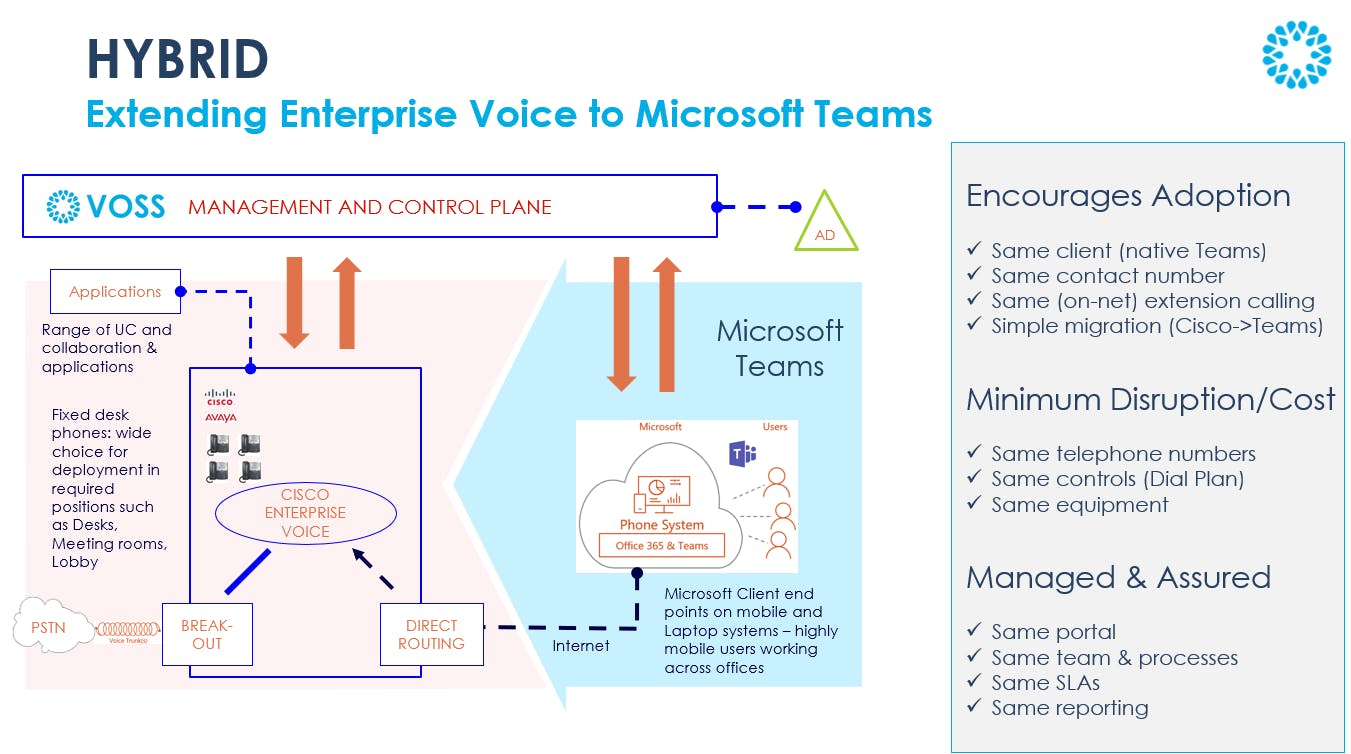
Hybrid calling with VOSS automation
The bank’s Cisco PBX was connected into Microsoft Teams Phone via Direct Routing to offer an integrated solution with a single number inventory. Users could then be freely moved between systems, keeping their number, with the ability to call out to the public telephone network. VOSS automation was used to manage this movement, with the following user service profiles:
- A user with Cisco services (only) – the initial state for a user, pre-migration
- A user with both Cisco and Microsoft services (both sides ring on a call)
- A user with Microsoft Teams Phone (only) – the eventual end migration of a user
Users could simply be selected individually or in bulk, and moved, with the underlying dial plan mechanism and number management being orchestrated and tracked by the VOSS workflow, associated automation, and audit log.
The value
The solution offered benefits in terms of:
- A simple and straightforward migration for a user, improving user experience
- Retention of telephone number and call controls, as they were pre-migration
- A single portal to manage both systems, pre, during, and post migration
- A robust and fast migration process, with in built rollback if needed
- Automated workflows to remove complexity and errors from the process
- Repeatable operational processes – for example onboarding / offboarding a user
Keep up to date with our latest blogs and subscribe today