Creating a Successful Microsoft Teams Phone Solution for a Global Manufacturing Customer
Unlocking a global viewpoint of your UC stack, with local issue resolution, to deliver a non-stop service

Author: Tim Jalland
Solution Manager, VOSS Solutions
Thursday, May 16, 2024
Delivering a collaboration and telephony solution from a cloud platform such as Microsoft Teams sounds easy on paper. That isn’t the case when you’re working for a large global company that’s operating in many countries, across many sites and relies on the solution for its day-to-day operations. In this manufacturing company example, expectations are high and the responsibility for running a non-stop service falls heavily on the IT Team.
The specific challenges come down to:
- Full stack observability: Moving away from the multitude of multi-vendor components that make up the collaboration solution to a single portal with a global view, end to end, supported by a flexible data acquisition engine.
- Proactive not reactive: Getting onto the front foot with service delivery and improvement, and not relying on after-the-event alerts or poor customer feedback.
- Real-time: Working with dynamic up-to-date information, presented in an understandable format for information and action, not out of date data collected from the past.
- Improvement oriented: Aligned to business needs and continually adapting to meet service level agreements, user expectations, and future needs and requirements.
- Scale and reach: Designed with scale in mind, responsive to support a global operation.
Here at VOSS, we have created a blueprint for addressing this challenge. In this case, the customer is a large multinational manufacturing company specializing in building products, with 55,000 employees operating across 25 countries. Microsoft Teams and the phone system are at the core of the solution, supported by a range of applications, infrastructure, and equipment.
VOSS Insights was deployed in Microsoft Azure, creating minimal disruption to existing data center services. Access was provided to both global and local administrators, with suitable role-based access control. The task was to address the on-going monitoring, adaptation, and improvement of the service. Here’s our approach.
Full stack observability
Whilst the collaboration service was built around Microsoft Teams, the end-to-end solution encompassed infrastructure, operators, applications, users, meeting and conference equipment, endpoints, WiFi and headsets, and the Internet. There was a fragmented approach to service management, operated by a small team of highly technical engineers using native technical tools built into each component.
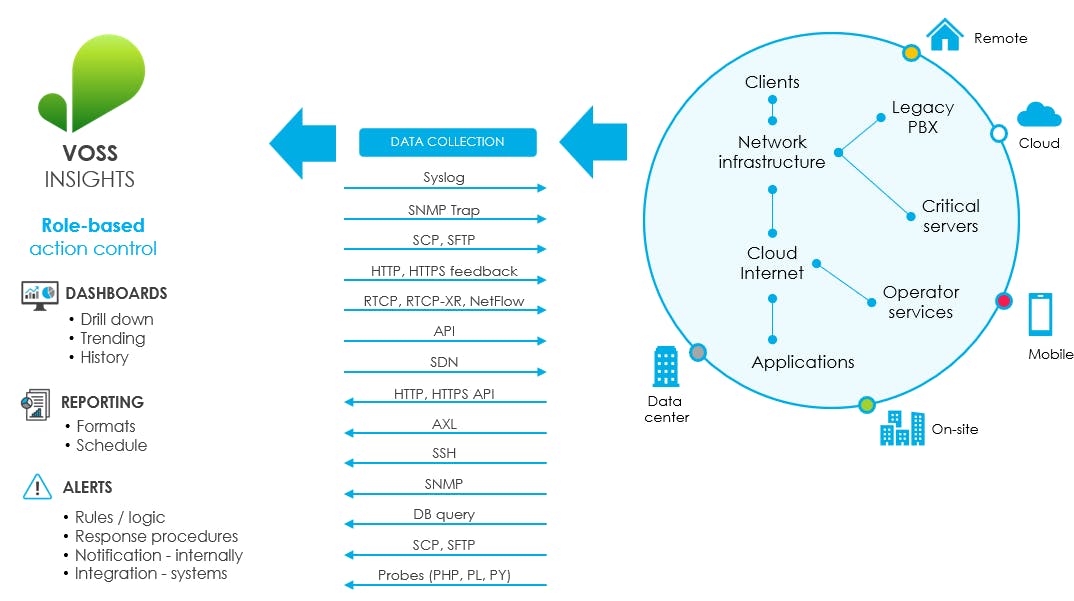
VOSS Insights overlaid this, providing a flexible data acquisition engine, as the diagram below shows, capturing information from the various sub-components, complementing this with additional data (such as location information), and then presenting this in a common format and language, on a set of intuitive business dashboards.
Proactive not reactive
Getting on the front foot with proactive service management is a key requirement. This means continual improvement, being ahead of conditions on the solution, and proactively working with users to optimize experience.
With VOSS Insights, the following mechanisms were deployed:
- The basics – Using probes to regularly monitor the status of various components in the network, extracting health statistics, using technologies such as ping, basic collectors, and SNMP. This was coupled with the collection of performance statistics, call details, usage, and related information from major platforms such as Microsoft Teams using API calls.
- Network performance – Using technologies such as network observability and Netflow to understand the dynamics of corporate networks, delivering performance and statistical information that can be used to pinpoint problem areas, align capacity, and generally improve the underlying transport layer.
- Synthetic testing – Deploying small ‘synthetic testing BOTs’ into regional sites and offices, to simulate and measure user activity on the collaboration service – for example how long does it take to join a meeting on Microsoft Teams! These BOTs represent artificial users and provide a continuous, automated, and proactive measure of the underlying collaboration platform.
Coupled with all the above mechanisms is a response procedure configured against certain thresholds, to take an action as appropriate – logging the condition, raising an alert, sending a notification, or taking a specific configuration action in the case of a self-healing condition.
Real-time
Important to the solution is to capture data as close to real-time as possible, to rapidly identify upcoming issues before they become a serious issue. That applies to various areas such as service availability, call and meeting quality, application performance, and service provider provision.
VOSS Insights provides flexibility to collect and correlate data on a near-real time basis, sifting out the noise to bring relevant information to the attention of the IT Team, for action and intervention.
Improvement oriented
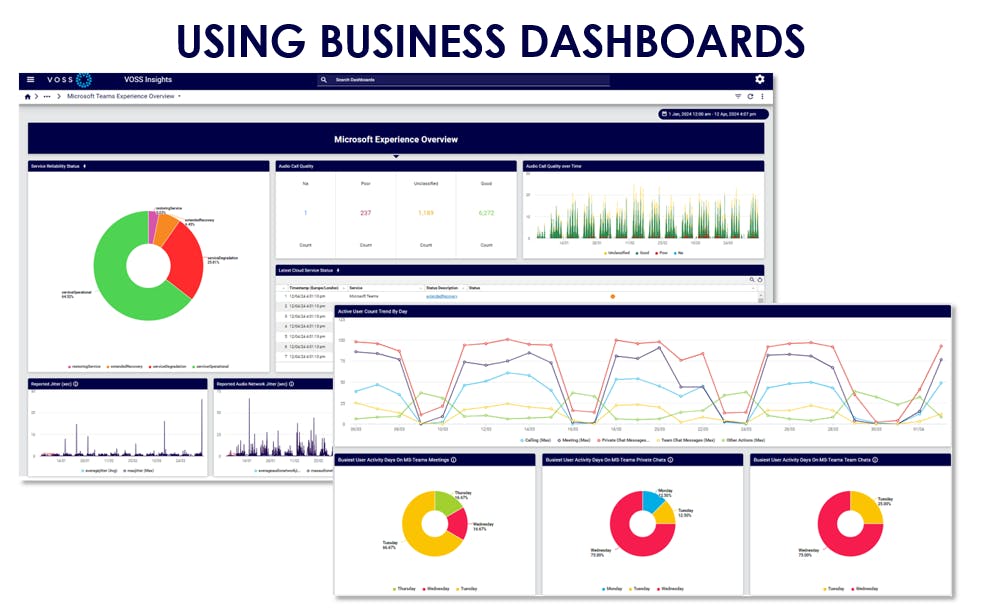
Capturing information from across the full stack and doing that proactively was one side of the solution. The other was to transform this into intuitive dashboards and meaningful information that supports improvement and action. In this case, VOSS presents a set of dashboards oriented around alerting, service monitoring and resolution, diagnostics, usage and adoption, inventory, and license tracking. Each dashboard provides tracking over time, with the period being configurable. Each dashboard also offers a filtering and drill down capability, from a global service view that’s needed by the global IT Team, down into the detail within each site, that’s required by local administrators Alongside the dashboards, VOSS Insights also provides a reporting capability to present summary information, on a regular basis, in a PDF report, to senior IT Managers around the business.
Here’s an example dashboard:
Scale and reach
Finally, across this full UC stack, there’s a significant amount of data collected. That’s stored, analyzed, and continually refreshed with regular updates from live data. VOSS Insights provides a modular and scalable architecture, with collectors deployed at appropriate points in the network, overseen by dashboard reporting services to provide a solution that’s both robust and scalable to cope with the demands of running a production large scale UC solution across multiple sites and locations.
More Information
There’s more information on VOSS for Microsoft, here. To discuss your full stack observability requirements, please get in touch with us here.
Keep up to date with our latest blogs and subscribe today