Taking back control: Transforming collaboration tools for AI productivity

Author: Tim Jalland
Program Director, VOSS
Tuesday November 12, 2025
Enterprises are investing heavily in collaboration and productivity tools like Microsoft 365, Teams, Webex, and Zoom. These platforms have become mission-critical, enabling communication, hybrid work, and productivity at scale. Yet for many organizations, these environments are still managed through portals and dashboards provided by service providers, systems integrators, or regional partners.
While this model offers convenience, it often leaves enterprises operating with limited visibility into usage, performance, costs, and user experience. As a result, IT leaders face challenges in answering fundamental questions:
- Are our licenses being used effectively?
- Is service performance meeting SLAs?
- Where are productivity bottlenecks occurring?
- What’s impacting user experience
- Are new investments in AI delivering the expected ROI
The hidden costs of poor visibility
Without a unified, dynamic view across their digital workplace, enterprises struggle to manage service performance proactively. Capacity planning becomes guesswork, leading to resource over- or under-provisioning. Service performance issues go unnoticed until they affect users, resulting in SLA breaches and reactive troubleshooting. License costs spiral, as organizations pay for unused or misaligned subscriptions. IT productivity suffers, as teams depend on external providers for simple change requests or data insights.
These challenges don’t just inflate operational costs; they also delay AI readiness. When systems, processes, and data are fragmented, enterprises can’t take full advantage of tools like Microsoft Copilot to drive intelligent automation and business value.
A new model: enterprise-owned visibility and control
Forward-thinking organizations are now taking back control of their collaboration and productivity environments. By introducing an enterprise-owned visibility, analytics, and automation layer, IT teams gain a single, dynamic view across the whole digital workplace.
This shift unlocks powerful capabilities:
- Proactive insight to identify inefficiencies and guide improvement actions.
- Automation to streamline service management, accelerate incident resolution, and sustain SLA performance.
- Optimized environments that are cost-efficient, resilient, and ready to support AI-driven innovation.
By aligning digital workplace management with ITIL best practices, enterprises can operate with greater agility, reduce dependence on external service providers, and build a digital workplace that’s primed for the next generation of AI tools.
Industry collaboration: Insights from UC Today
To explore this transformation in depth, VOSS partnered with UC Today to produce a dedicated content series highlighting how enterprises can reclaim control of their collaboration platforms and prepare for an AI-enabled future. The series includes:
Without visibility into usage, costs, and performance, businesses are flying blind. In this article, UC Today explains that with the right insight and control, IT leaders can cut spending, boost service delivery, and build a foundation for true AI-driven transformation.

How to cut UC costs and boost productivity with proactive insight and automation
Most enterprises have invested millions in Microsoft Teams, Webex, and Zoom, yet remain in the dark about what they are truly getting for their money. Blind spots around license usage, performance, and user experience leave IT leaders exposed to increasing costs, SLA risk, and limited AI readiness. This is where VOSS comes in. Here, UC Today explains how organizations are regaining control with unified visibility and automation.
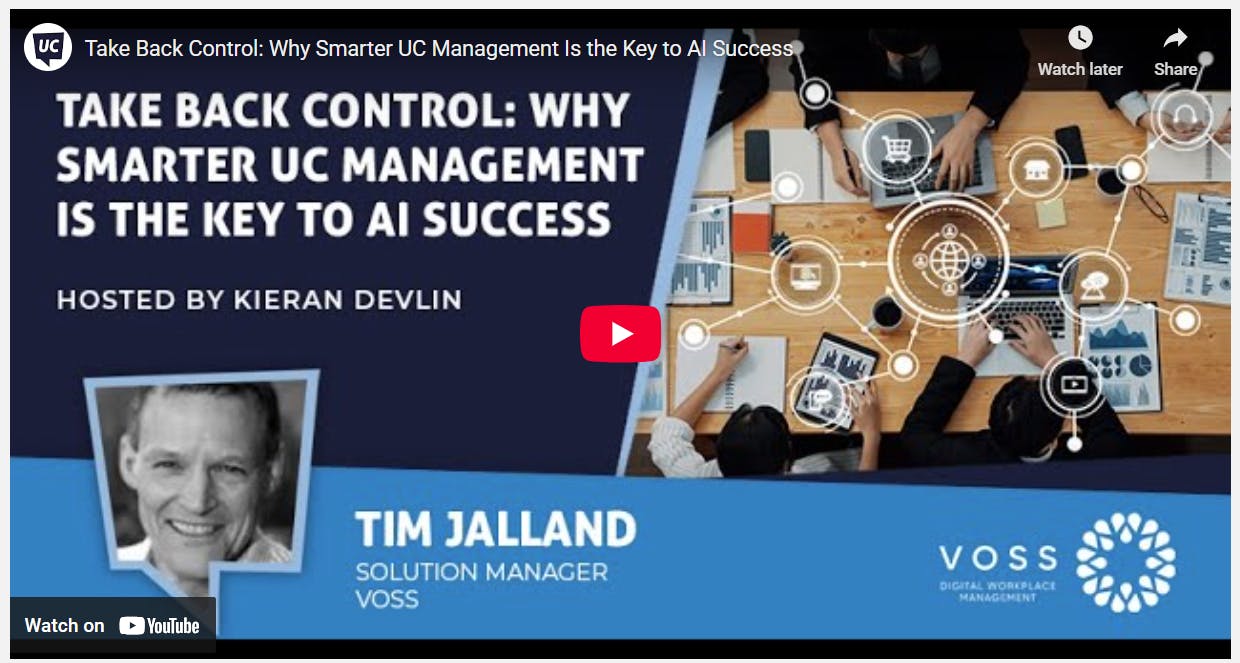
Take back control: Why smarter UC management is the key to AI success
In this interview, host Kieran Devlin talks to Tim Jalland about how enterprises can regain visibility and control of their UC environments. As hybrid work, cloud migrations, and AI adoption increase complexity and costs, Tim explains that VOSS is empowering IT teams to modernize management, make data-driven decisions, and prepare for an AI-enabled future.
The takeaway
Taking back control isn’t just about cost savings or efficiency; it’s about owning the strategic direction of your digital workplace. Enterprises that unify visibility, automate intelligently, and manage proactively will be best positioned to embrace AI, empower employees, and drive measurable business value. To discuss taking back control of your digital workplace, please get in touch.
Keep up to date with our latest blogs and subscribe today