
VOSS survey reveals UC challenges and trends facing large enterprises
Author: VOSS Team
Tuesday April 15, 2025
As UC becomes an integral part of the digital workplace, understanding how organizations are navigating their UC journey is more important than ever. From migration hurdles to hybrid work challenges and the growing influence of AI, businesses are operating in a rapidly evolving landscape.
In this blog post, we share key findings from a recent VOSS survey of large enterprise organizations, which highlights major trends, common pain points, and actionable insights. Whether you’re an IT manager or a business leader, you’ll find your peers share the same challenges, and we offer some tips on how to overcome these and stay ahead of the curve. Read on to explore the results.

UC migration: The key pain points
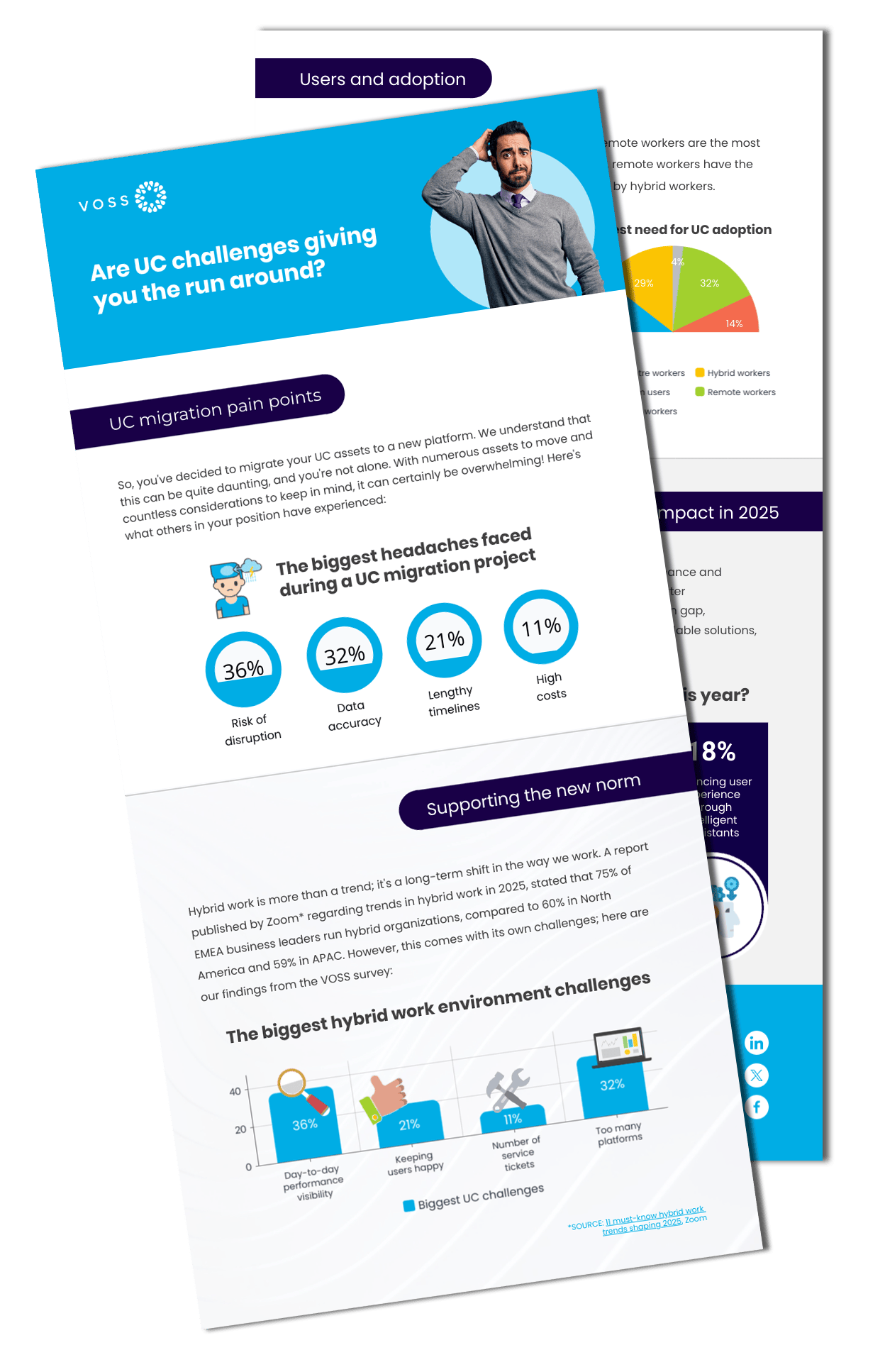
Migrating UC assets to a new platform can be a daunting task. Our survey revealed that organizations face several challenges during UC migration. The biggest hurdles include:
- Risk of disruption (36%): The threat of service interruptions during the migration process is a major concern for many organizations.
- Data accuracy (32%): Ensuring the integrity of data during migration is critical yet often proves to be a challenging task.
- Lengthy timelines (21%): The complexity of migration projects often results in extended timelines, delaying business continuity.
- High costs (11%): The financial burden of UC migration can be significant, with many organizations struggling to stay within budget.

Supporting the shift to hybrid work
Hybrid work is no longer just a trend – it’s a fundamental shift in how organizations operate. Our survey revealed the following key challenges in managing hybrid work environments:
- Day-to-day performance visibility (36%): Businesses are struggling to maintain visibility over the performance of their UC systems, especially in hybrid settings.
- Too many platforms (32%): The proliferation of different tools and platforms has led to inefficiencies and user confusion.
- Keeping users happy (21%): Ensuring a smooth user experience in a hybrid work environment remains a top priority.
- Number of service tickets (11%): The volume of service tickets increases with the complexity of hybrid work, creating additional strain on IT teams.

Barriers to adoption
While UC is essential to business operations, many organizations face significant barriers to adoption. The top challenges are:
- Cost (43%): The financial investment required for UC implementation remains the number one barrier for organizations.
- Lack of integration (29%): The inability to integrate UC solutions with existing systems slows adoption and creates friction.
- User resistance (18%): Some employees are reluctant to adopt new UC systems, slowing down the transition.
- Dispersed workforce (11%): Managing a geographically dispersed workforce creates unique challenges for UC adoption.

The role of UC analytics
Analytics is a key component for optimizing your UC stack. Our survey results show that a vast majority of organizations recognize the value of UC analytics:
- 64% of respondents could not imagine managing their UC operations without analytics, underscoring the importance of real-time insights in maintaining smooth operations.
- Only 29% felt they could possibly manage without analytics, while 7% operate without them entirely.
Without effective analytics, organizations risk missed opportunities and longer downtimes. Implementing a comprehensive UC analytics solution is critical for optimizing performance and ensuring a seamless user experience.

Estate visibility: How well are UC licenses being managed?
Visibility into your UC assets is crucial for managing resources effectively. Our survey revealed the following insights:
- 54% of respondents are confident that they know how their UC licenses are being used, but there’s still room for improvement.
- 39% are aware of most of their license usage, while 25% would benefit from better visibility.
- Only 7% of organizations don’t have visibility into their licenses, but it doesn’t seem to be a significant concern.
In our experience, understanding and managing UC license usage is essential for optimizing costs and ensuring that resources are allocated efficiently.

Cloud vs. on-premises UC environments
The shift to cloud-based UC solutions is undeniable. Our survey results show:
- Up to 25% cloud-based: 14%
- Up to 50% cloud-based: 32%
- Up to 75% cloud-based: 36%
- Up to 100% cloud-based: 18%
As cloud adoption increases, organizations need to assess their readiness and strategies for full cloud migrations or hybrid environments.

Users and UC adoption
Managing different user groups presents distinct challenges. Our survey highlighted the hardest user groups to manage:
- Contact center workers and remote workers (32%) were identified as the most difficult groups to manage.
- Hybrid workers (21%) also face unique challenges, especially in terms of consistent access and collaboration.
- Interestingly, remote workers have the highest need for UC adoption, closely followed by hybrid workers.
Understanding these user needs is critical for IT leaders, so that they can design tailored UC solutions that improve adoption and user satisfaction.

AI’s role in UC
AI is already having a heavy influence on the UC space, and our survey results show where AI is having the greatest impact:
- Automating routine tasks and workflows (32%): AI’s ability to handle repetitive tasks can free up valuable time for employees and streamline workflows.
- Reducing service tickets with proactive issue resolution (29%): AI can help address issues before they escalate, reducing the number of service tickets and improving system performance.
- Improving analytics and insights for decision-making (21%): AI will enhance decision-making by providing more accurate and actionable data.
- Enhancing user experience through intelligent assistants (18%): AI-powered virtual assistants can significantly improve the user experience by providing on-demand support.

What these insights mean for IT leaders
We found the results of the VOSS UC survey fascinating, providing a wealth of valuable insights on how IT teams and organizations are looking to improve their UC environments. For those responsible for the UC stack, understanding these challenges and opportunities will help you guide your team towards more efficient, cost-effective, and user-friendly UC solutions. By addressing key issues such as performance visibility, cloud adoption, and AI integration, you can empower your company to create a future-proof UC infrastructure that drives business success.
Contact VOSS to share your thoughts on how the survey results compare to your experience, or discuss how we can help.
Keep up to date with our latest blogs and subscribe today