From monitoring to mastery: Why governance is the missing link in digital workplace management

Author: Jamie Litherland
Solution Manager, VOSS
Tuesday, January 20, 2026
As we move into 2026, enterprises are entering a new phase of Microsoft cloud maturity. Most organizations now have strong monitoring foundations in place; they can see what’s happening across their collaboration environments with more clarity than ever before. Dashboards, performance metrics, and alerting capabilities have become commonplace. But this visibility highlights a deeper truth: Monitoring alone is not enough. To truly optimize and protect a modern Microsoft tenant, organizations need governance – the ability to shape how their environment behaves, not just watch for what goes wrong.
Where visibility ends and governance begins
Monitoring tools excel at telling IT teams when something breaks or drifts out of alignment. What they don’t explain is why these issues occur in the first place, or how to prevent them from recurring. Many enterprises still struggle with inconsistent configuration standards, unclear ownership, rising license costs, and unpredictable user experience across regions. They can see the symptoms, but they lack the overarching structure to prevent them.
This gap is more pronounced in global organizations. With multiple regions, business units, and local administrators, Microsoft 365 environments naturally become fragmented over time. A change made in one region might contradict a global standard; a misconfiguration in one country can introduce risk for the entire organization. Monitoring highlights these inconsistencies, but only governance can eliminate them.
The shift from reactive to proactive operations
True governance transforms digital workplace operations from reactive firefighting to proactive management. Rather than waiting for alerts to signal a problem, IT teams establish rules, guardrails, and processes that keep the environment secure, compliant, and efficient by default.
This shift requires more than dashboards. It depends on having structured processes, aligned roles, clear boundaries, and tools that enforce policy across the entire Microsoft ecosystem. Without governance, even the most advanced monitoring platform acts only as a rear-view mirror.
How VOSS enables governance across Microsoft 365
VOSS closes this gap by enabling our customers to automate and control their Microsoft environments with precision. Instead of treating monitoring as the final step, VOSS integrates it into a wider governance framework that shapes the entire operational lifecycle.
At the heart of this approach is policy-driven automation, which ensures environments behave consistently no matter how large or distributed the organization becomes. Routine operations such as provisioning, configuration updates, and license assignments follow predefined rules – reducing risk while maintaining global standards.
Delegated administration adds another layer of structure. By aligning permissions directly to a customer’s hierarchy, VOSS allows regional teams to act independently without compromising security or consistency. This balance of autonomy and control is critical for large enterprises operating across multiple time zones and regulatory environments.
Hierarchy modeling ties everything together. VOSS mirrors the company’s real-world structure inside the management platform, making it possible to apply policies that align with business reality – not generic templates. Instead of managing one giant tenant, IT teams gain a clear view of departments, regions, subsidiaries, and service boundaries, making governance scalable and intuitive.
The business impact: Cost, compliance, and consistency
When a VOSS customer adopts governance as a core operational principle, the results extend far beyond efficiency. Costs become more predictable as license usage stabilizes and misconfigurations decrease. Compliance risk reduces because only authorized users can make changes, and every action is traceable. And perhaps most importantly, user experience becomes more consistent, with fewer disruptions and greater reliability across the business.
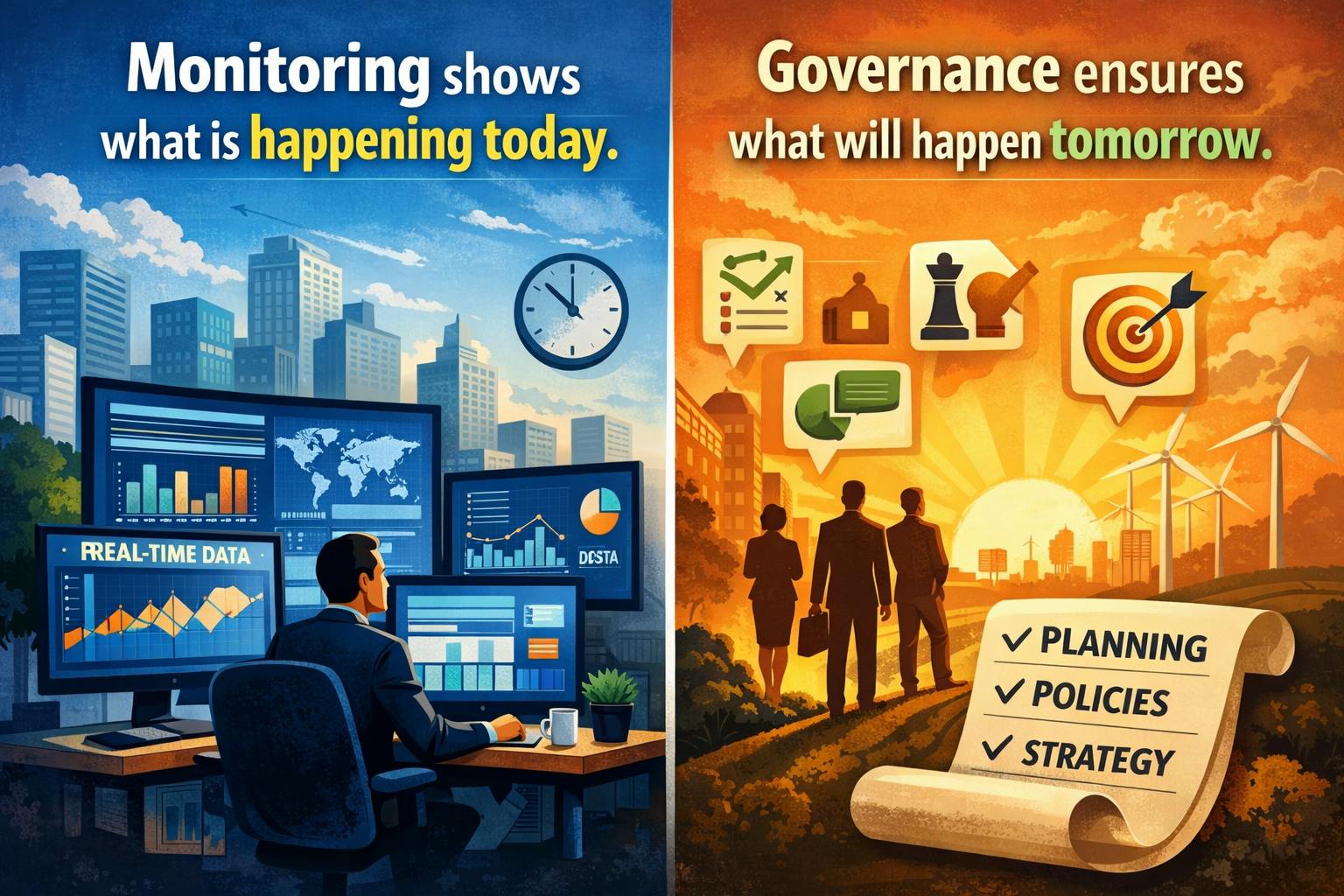
Monitoring shows what is happening today. Governance ensures what will happen tomorrow.
A smarter way forward for 2026
As enterprises continue to scale their Microsoft environments in 2026, the gap between visibility and control will become even more significant. Observability platforms will keep evolving, but without governance they can only react to what has already occurred.
The organizations that thrive in the year ahead will be those that treat monitoring as a component of their strategy – not the strategy itself. Governance is the missing link that transforms insights into action, policies into stability, and complexity into clarity. VOSS gives our customers that capability. We turn monitoring into mastery. To find out more, please get in touch.
Keep up to date with our latest blogs and subscribe today